Sunday, September 10, 2017

Why Your Latte is $5 a Pop - My Coffee Farming Experience


For the past three months, I've been living and working on Mama’s Kona Coffee farm in Keauhou-Kona, Hawaii. After working in the coffee business for three years, and drinking A LOT of coffee, I decided to take things a step further and really experience the journey that coffee makes from the tree to the cup. My goal in my professional career is to improve access to healthy foods and bring urban society closer to our food through gardening or small-scale farming, cooking, and nutrition education. As processed and streamlined as our food is in the modern day, it's hard to remember that there are human beings behind the convenience of grocery stores.  

Every coffee drinker has heard the criticism: “why would you pay $5 for a drink?” and
in my three years of coffee-making, one of the questions I heard the most was “why is coffee so expensive? Isn't it just beans and water?”

My answer back then, before I really had knowledge of the nature of coffee farming, was usually “well, the cost includes the cup and lid, milk and flavor, employee pay, and rent for the building”. Which are all real reasons when buying specialty coffee from a cafe, but coffee by the pound tends to be pricey, as well, especially when compared to other popular steeped drinks like tea.

Now, my answer includes all of the reasons above, but includes this, as well: coffee farming is hard. It's simultaneously physically challenging, mentally frustrating, and environmentally delicate. And for the farmer, it often isn't always very profitable. The farm I worked on supplemented their income by selling baked goods and meals at a farmer's market. When you consider that the majority of coffee is grown outside of the United States in countries with poorer working conditions and labor ethics, commercial coffee is actually under priced.

So what makes coffee farming in Hawaii, home to some of the best coffee on Earth, so challenging?

  • Environmental Factors
    • Coffee plants are very particular about the conditions they grow in, and only grow in very specific climates. While it loves and thrives in Kona’s volcanic soil, moderate year-round temperatures, and frequent rainfall, any deviation from the normal weather is damaging. Periods of drought and acid rain have made it harder for farmers to maintain healthy crops in recent years.
  • Invasive Species (and other pests!)
    • While Hawaii’s climate is perfect for growing coffee, it's also perfect for nearly any living organism. Farmers in Kona now have to tackle invasive coffee borer beetles and fire ants. Fire ants not only feed on fruit, but pose danger to farmers and coffee pickers with their painful sting.
  • Caretaking of Plants
    • Mentioned above, if it doesn't rain, coffee farmers have to water the plants by hand or with irrigation. This is costly both financially and environmentally for the farmer and the land.
    • New growth on fruiting trees, called suckers, literally suck nutrients away from the coffee cherries and plants themselves. These are pulled or cut off before picking season.
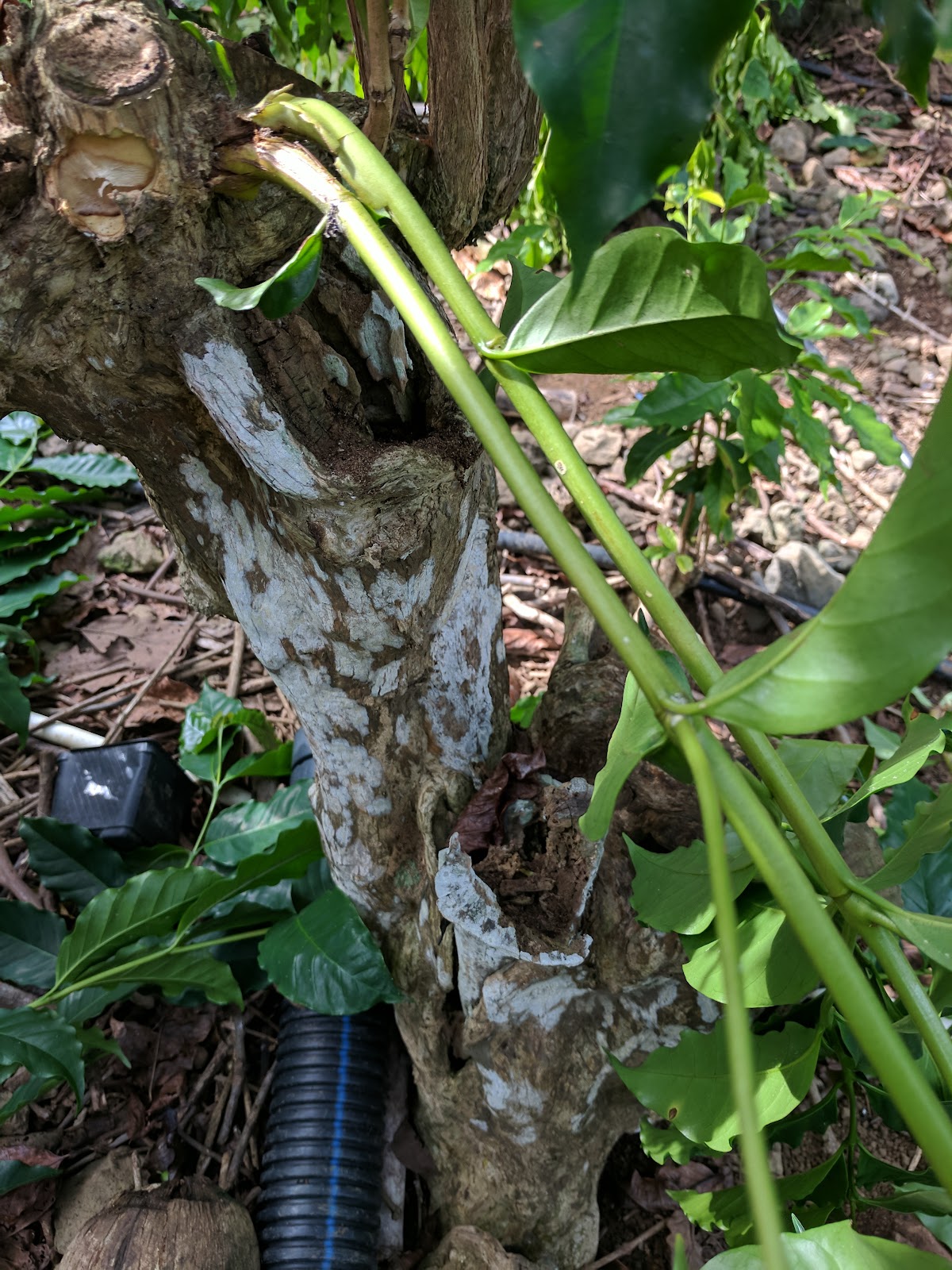
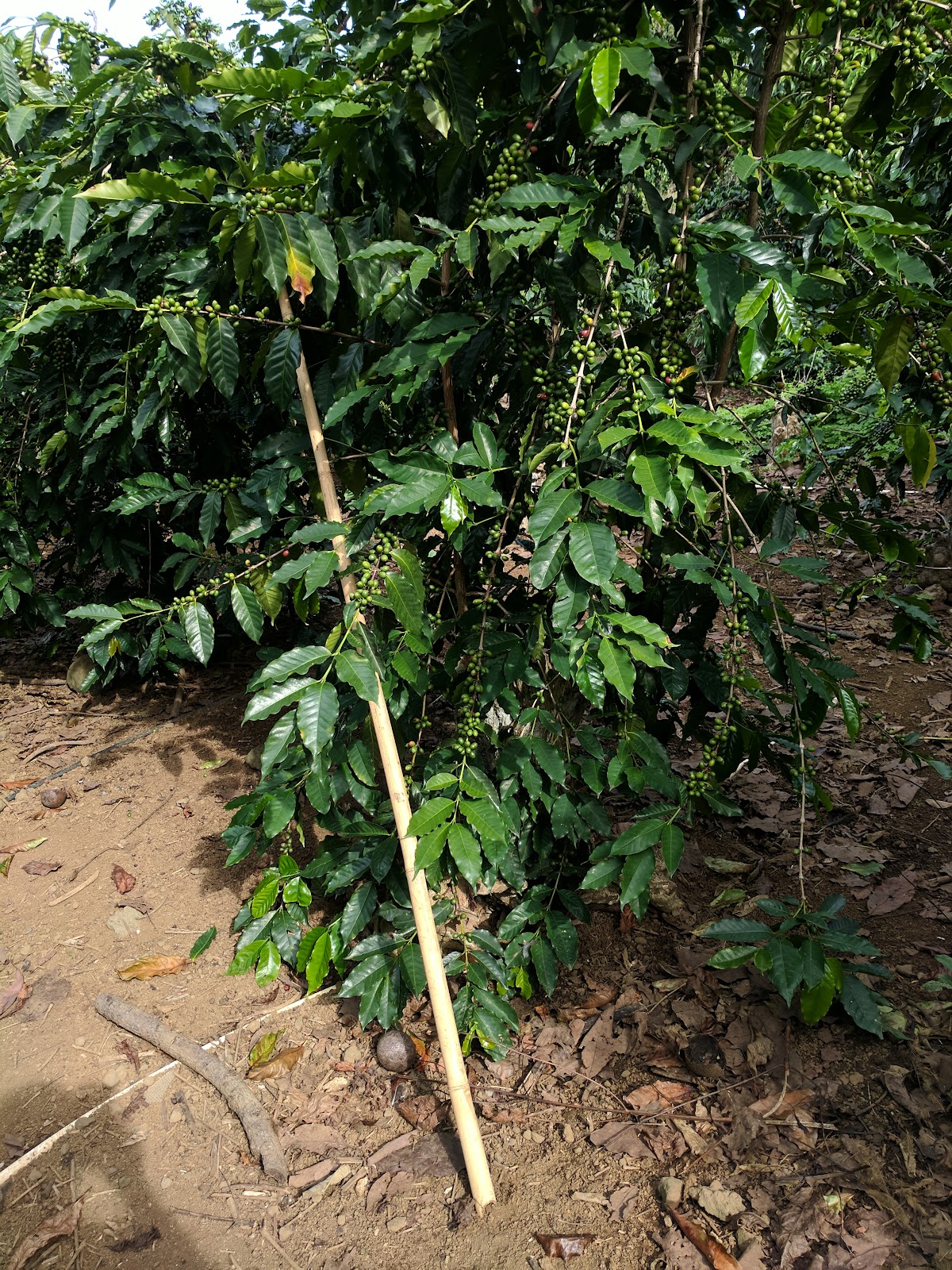
    • As coffee beans develop, they weigh down the tree’s branches. The main stumps of the trees, called verticals, start to bend and need to be propped up so that they don't snap in two. Verticals can be heavy, and propping them up just right takes time.
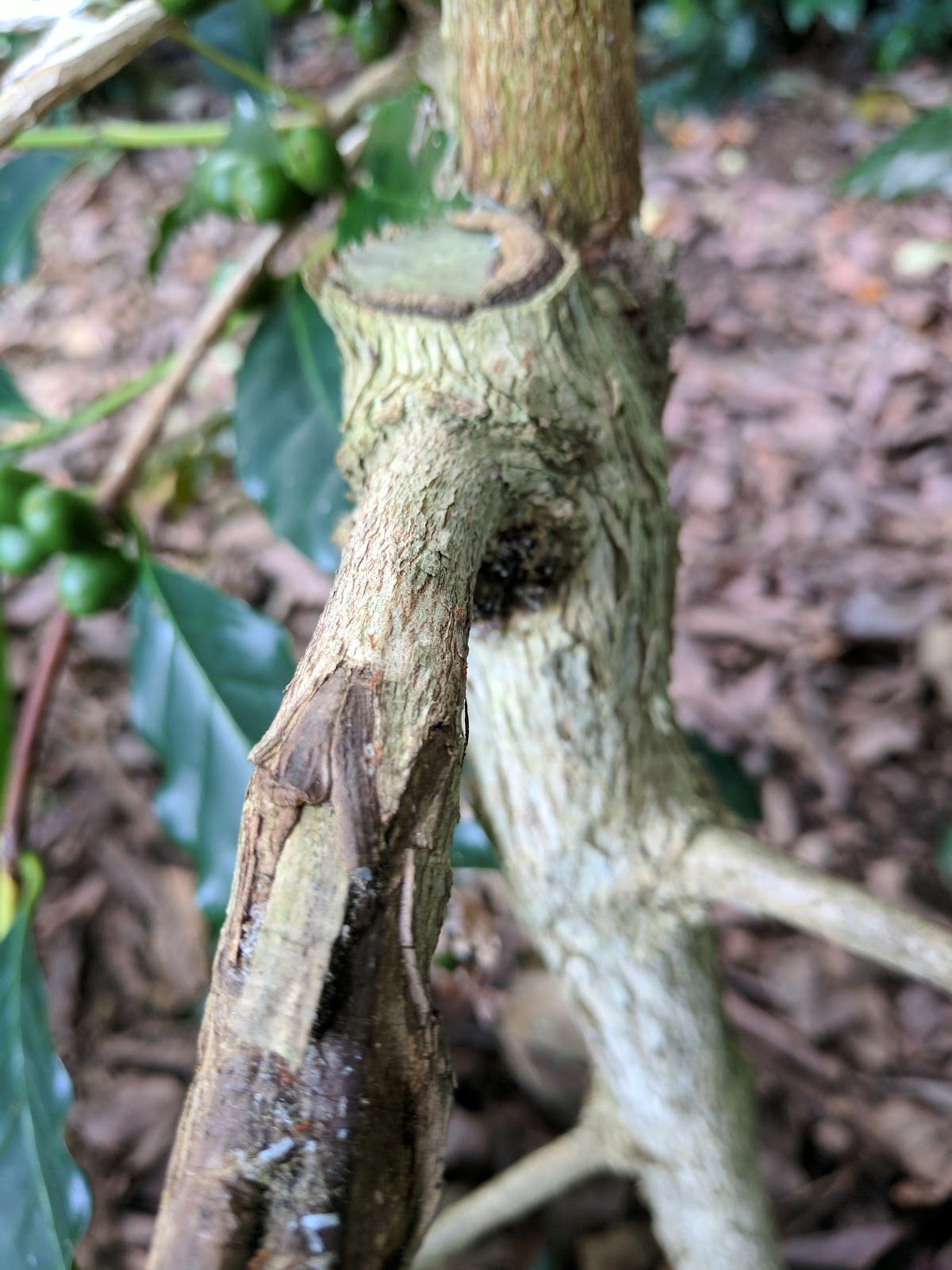
    • The way beans are harvested is important, too. Careless pickers can damage the plant at the point the cherries grow on. New cherries should grow on the plant in the same spot during following seasons. If cherries are picked incorrectly, though, the plant scars and no cherry will grow there again.
  • Processing of coffee
    • Some farmers process their own coffee: from  pulping, drying, roasting and bagging, which is all time-consuming work. Others send coffee harvests off to be pulped (removes the fruit from the bean), and finish the drying and roasting process themselves.
    • Roasting coffee is a rewarding experience, but it's also extremely hot, and the smoke burns your throat, lungs, and eyes if you don't wear proper protection. Not all farmers roast their own coffee, but it is a common process in Kona, where farms often go to market to sell their products and hold tours and coffee tastings.

As harvest season approaches, I'm looking forward to doing some coffee picking, though I’m not living on the farm anymore. Coffee farming (as any farming is, really,) is a labor-intense lifestyle, but I found being in the land to be calming and meditative. In fact, Lily Sr., or “Mama” as we all call her, is in her 90s and still goes out to take care of the land every day, having done so since she was a child. She was usually out before we would even be awake. She says it keeps her mind and body young, and seeing her out there, I believe it.
Farming coffee opened my eyes to the struggles that coffee farmers around the world likely face, and I've gained a new appreciation for one of my favorite beverages and the people that grow it. It brought me closer to the land, where I found confidence and gratitude to every little thing that went “right”. So I encourage you, next time you order your small, hot, honey-almond milk latte with cinnamon sprinkles (my fave ;) ), take a moment to be thankful for what you have, and for the people whose lives and livelihoods rely on that cup of roasted bean ambrosia!


Monday, March 13, 2017

A time to celebrate! / Vegan-Friendly Spinach Artichoke Dip

"To everything, turn, turn, turn.
There is a season, turn, turn, turn.
And a time to every purpose under heaven"
Turn! Turn! Turn! By the Byrds is my second favorite song of all time, right after "My Heart Will Go On" by Celine Dion (I definitely had my dad request it on the radio when I was six). I loved this song growing up, and the verse in the Bible that inspired it is also still one of my favorites. The seasons are turning here in Phoenix, it's getting hot during the day, so Spring is here. The seasons in my life are turning, as well. If I could summarize with one line from the song how life has been lately, it would be "a time to build up" because I'm building on everything I've worked hard for since last year.

Here's a recap of my 2017 so far:

Music school audition - could go either way, either way I'm happy I tried!

Presentation for Thrive families - Thrive is a new, local non-profit here in Arizona that focuses on providing support and basic needs for families at risk of being put into foster programs. I had the opportunity to share my story and a few budget and kid-friendly healthy recipes (here). It was an amazing event and I met so many incredible, beautiful people through it!

CSA Takeover for Monika Woolsey at Hip Veggies) - honestly my RD hero (she’s a sports nutritionist for the Brewers, supports local and native foods, and uses art to market healthy foods and combat food insecurity. Literal career goals.), Monika asked me if I'd like to do a takeover of her CSA box this month and share my creations. This was a huge opportunity for me and my blog to be seen as well as an amazing way for me to learn and push myself creatively! I can't thank her enough! :)

With so many things to celebrate, I thought it was appropriate to share a fun, celebratory party-food recipe which features a couple vegetables from the CSA Takeover! Note the “party food” aspect! It is vegan, so there is no cholesterol, less fat, and less sodium than regular dip, but it's still a food that should be enjoyed in moderation!

Creamy Vegan Spinach and Artichoke Dip


1 cup chopped artichoke hearts
2 cups steamed and cooled spinach
¾ package firm silken tofu
½ cup vegan cream cheese
2 tbsp cilantro or parsley
1 i’itoi onion or scallion
2 tsp red hot sauce of choice (Cholula is my jam)
1 tsp White vinegar

  1. Steam your spinach. You should have about 1 cup after it's been steamed. Drain any excess water and allow to cool to room temperature. You can also use thawed frozen spinach.
  2. Clean and slice the white bulb of your onion up to the point that it turns green.
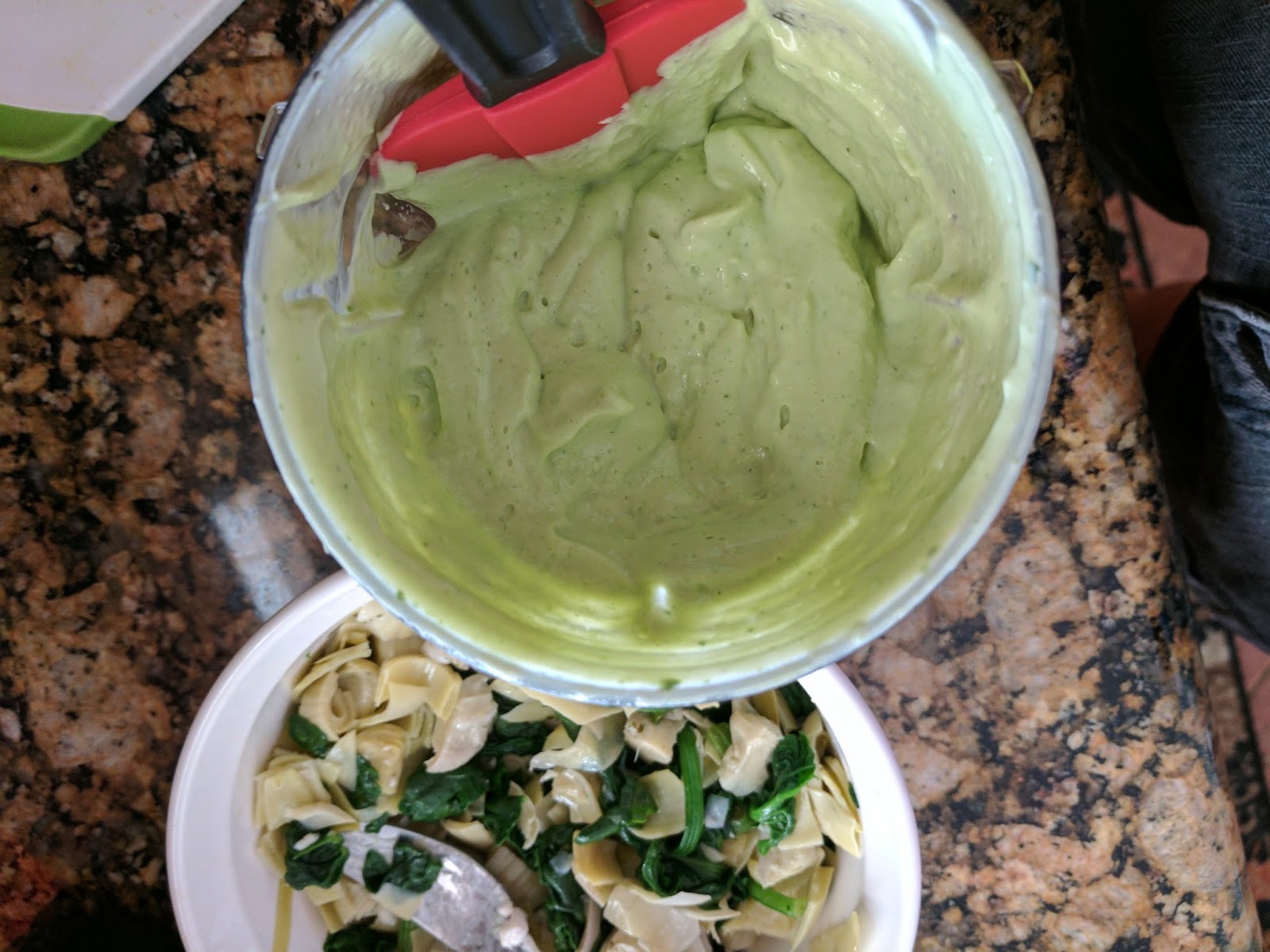
  3. Add the onion whites, cilantro, tofu, cream cheese, hot sauce, and vinegar to a blender or food processor and blend until smooth. It should be the texture of Greek yogurt.
  4. Chop the artichokes into bite-sized pieces and add to a bowl with the spinach.

  1. Add the cream mixture to the spinach and artichoke and mix well so that everything is evenly spread throughout the dip.
  2. Taste and add more hot sauce if you so desire :)
  3. Slice the green portion of your onion and sprinkle on top along with black pepper to taste.
  4. Serve with corn chips, pita chips, raw veggies, or anything else you might think would go well with it!

For this recipe, I used Daiya’s plain vegan cream cheese replacement. If you want to go all out, this recipe makes a good cashew cream cheese: https://www.healthfulpursuit.com/2012/12/how-to-make-soy-free-vegan

If using frozen spinach, cut the amount listed in half, measuring only 1 cup of thawed spinach.

I hope that 2017 is treating you all well, too! If it isn't, remember, there's a time for everything under the sun - your time of peace is coming :) 

Wednesday, February 1, 2017

Simply Real: Part 2 + Some Updates!

 Life has taken a turn for the busy as of late, and what I thought was manageable at one time has turned out, in all honesty, not to be. Can't always plan and account for those uncontrollable factors in life like car accidents and not having a place of your own to cook and practice, ya know?

Regardless, life in my personal realm is actually quite nice right now. When you consider the big picture when it comes to the state of our world, you realize how blessed we really are, despite the inconveniences of modern life in a first world nation. My car got hit, but at least it still drives and no one got hurt. My name isn't on a lease right now, but at least I have a bed to sleep in at night. Matthew 6:26 says "Look at the birds of the air: they neither sow nor reap nor gather into barns, and yet your heavenly Father feeds them. Are you not of more value than they?" I'm working towards a new place to call a home of my own, but I'm at peace until then. I'm feeling very drawn to a minimalistic lifestyle lately. For real, I could be content living in a tent in the desert (could just be I'm totally over moving stuff around to a new place every year, haha).

The audition for music therapy school is quickly approaching, and though I've experienced different levels of anxiety over it during the past few months, I've come to settle with whatever happens in peace. Whether I get in or not, whether I'm actually able to attend school if I get accepted, I'll be happy knowing that at least I tried, and my love for music is and will continue to be alive and well. I participated in a monthly jam-session night in December. It was rad. I met some cool people, and played music. I'll keep doing that if I don't get into school.

And if I don't get into school, my focus is going back into gardening, and farming, and sustainable food systems. This year, I want to learn more about agriculture. I'm attending meetings with a group of beekeepers in Phoenix to learn more about raising our lil buzzy friends, and even more exciting, I'm going to WWOOF this summer! WWOOF is a program which allows those agri-curious wanderers to live somewhere besides their home while learning hands-on about farming and agriculture. I'm seriously so excited about this, and am in the process of contacting some farms to go work on! Sustainability and taking care of creation is something I've always cared about, ever since I was a wee, 4-year-old rescuer of endangered butterflies. I'm ready to participate and be an ambassador for changing our food system to make it better for the long-term.

Finally, if you've been following along with the Simply Real series over the past several months, you've learned about the things that make our food healthy, and what it means for a food and a person to be "healthy". So you know the why's, but now how do you use that knowledge? Perhaps you already have a solid (or even decent) understanding of how to cook. You might be good to go! If not, this next part of the series will focus on:
  • Recipe literacy
  • Cooking methods for different foods
  • How to customize and create your own recipes
 I'm excited for what 2017 is about to bring! 2016 was, for me personally, the greatest year I have experienced in a very long time. I'm praying that 2017 is similar, but if it isn't that I'll have the patience, strength, and peace of mind to deal with whatever happens.

Wednesday, December 28, 2016

Micronutrients Part 2: Minerals!


Here we are at last; the final cold, hard science edition of “Simply Real”. You’ve been introduced to ideas about what health and health food are (that’s less science and more my science-and-experience-based opinion), macronutrients, and now micronutrients. You have a basic, but thorough understanding of what foods are nutrient-dense, what nutrients are in specific foods, and even how these nutrients benefit your body.

Today, we dive into minerals – the “inorganic” cousins of vitamins. Vitamins are different from minerals because they are made of several different types of elements, and can be broken down. Minerals are made of only one element. Think back to your early science classes in elementary and high school and imagine the periodic table. You probably remember common elements like helium, hydrogen, and carbon. Minerals in nutrition are elements that the body uses, and they aren’t broken down like vitamins.

The functions of vitamins and minerals are also different. Remember that the vitamins usually “helped” things in the body happen: they help store things, they help build things, they help release and activate things. Minerals serve to maintain “balances” in the body in addition to being building blocks. Electrolytes are minerals that you may be familiar with, and we’re about to find out what they really do.

Mineral
What does it do?
Why is it important
Where to find it in Food!
Calcium
Part of bone structure
Electrolyte
Role in blood clotting
Lends strength and structure to bones
Helps our muscles function
Cool fact: our bones are storage for calcium and release it when we need to use it free in our blood.

Milk and dairy products
Almonds, green leafy vegetables, broccoli, fish with bones (sardines)

Sodium
Sodium is an electrolyte
Maintains fluid balance in our cells
Muscle movement, including the heart
Maintains pH
Table salt
Seafood
Milk
Processed foods (not ideal J )
Potassium
Electrolyte
Heart function and muscular function
Fluid balance
Maintains pH
Bananas
Potatoes
Beans
Dark leafy  greens
Mushrooms
Magnesium
Immune health
Electrolyte
Bone health
Energy and protein production in the body
Blood sugar regulation

Important factor in building certain immune cells.
Bone structure

Dark leafy greens
Avocados
Nuts and seeds
Fish
Yogurt
Dark chocolate :D
Phosphorus
Bone and tooth health
Protein building in body
Metabolism of carbs and fats
Component of structure
Body maintenance
Energy production
Milk + dairy
Meat
Nuts
Phosphorus from animal foods is actually more easily absorbed than it is from plant foods.

Manganese
Development of body structures
Calcium absorption
Carb and fat metabolism
Brain and nerve health
Helps in the production of connective tissues (skin, ligaments, fibers that hold everything together)
Part of certain clotting factors (things in the body that help blood clot)
Builds bones and stores calcium
Energy production and use
Whole grains
Nuts
Leafy greens

Selenium
A trace mineral – needed in smaller amounts.
Builds proteins that prevent oxidation
Remember from the vitamins post that oxidation is what causes aging, inflammation, and general bad things in the body.
Selenium builds antioxidant enzymes which help prevent this process in the body.
Fish
Grass-fed meat (specifically grass-fed, because the selenium content of meat depends on the content that is in the food the animal ate!)
Whole grains
Nuts + seeds
Plant foods are the best source of selenium J
Copper
Blood vessel and nerve health and function
Blood cell production with iron
Iron absorption
Copper is another trace mineral, but it is important!
Iron is needed to keep blood cells healthy and oxygenated. Copper helps with iron absorption.
Helps keep nerves healthy and fresh.
Dark Chocolate
Seafood and meat
Zinc
Cell division (regeneration of our bodies, basically)
Healing wounds
Immune function
Smell and taste function

Zinc plays a role in the reaction that allows our cells to create more cells. This is important for obvious reasons (if your cells aren’t replicating, you’re dead, so…)
Enhances and speeds wound healing
Dark chocolate
Seafood and meat
Iron
Required for the production of red blood cells
Red blood cells carry oxygen in our body and play a role in fluid balance.
Meat
Fish
Nuts
Leafy greens
Animal-based iron sources are absorbed more easily in the body. However, plant-based sources can be absorbed better when iron-rich foods are combined with vitamin C. Think spinach salad with strawberries!
Iodine
Thyroid health
The thyroid is an important organ that regulates metabolism and produces hormones and immune cells.
Iodized salt
Oysters + other shellfish
Seafood

Sunday, November 27, 2016

A Song for Chuck

Last night, I went to Glendale Glitters, an annual holiday festival here in Phoenix. I went to see the lights with my friend, and I took my viola along with the intention to get over my anxiety of playing in front of people by myself for the first time in several years. While I was there, I met a man named Chuck.
Chuck is homeless.
Every day, he picks up cans and scrap and takes his findings to a scrap yard, where he recycles it for money.
He does this not to support an addiction or other vice, but because he is trying to rebuild his life from that.
Chuck was a business owner at one time.
Chuck was a carpenter.
Chuck was a fan of Led Zeppelin (he asked me to play “Stairway to Heaven”, I did my best to translate it on the viola).
And, I think what struck me most: Chuck was a violinist.
He stopped to listen because the sound was sweet, and familiar. He told me he played from 3rd grade until he graduated high school. He played it until a carpentry accident caused him to lose the fingertips, and his sense of touch, on his left hand. Even after that, he taught himself to play with his opposite hand.
Chuck made mistakes in life, as we all do, which led him to where he is now, but he hasn't let that define him. He’s owned it, and he works hard - despite appearances and society’s perspective - to better his life now. He lives part of the time with a group of young adults who are on the path he took years ago, and he tries to convince them to better themselves now. He applies for jobs with a friend’s tablet.
I offered him the money that I had gathered from people passing by, but he refused, insisting that I’d earned it playing my music, and that I should keep it.
Chuck is a human being deserving of compassion, living in an uncompassionate world.
For an hour last night, I was blessed with the incredible honor of playing music for a man who probably appreciated it more than anyone else I'll ever encounter, because for that hour, someone saw him not as homeless, not as an ex-con
vict, but as a human being.
soli Deo gloria

Saturday, October 22, 2016

Me, a Molecule

Time for a little science talk. Don't worry, this is actually pretty exciting stuff.

Yo, that title would be a great song title, too. I'm feeling inspired like no other this morning! 

Proving that I am indeed a normal person who happens upon ideas is normal person ways (I'm really not all that enlightened), I was in the shower today when my thoughts went on one of those wild rabbit trails that ends up with me being like, “oh wow I should write that down”! But then I never do.

Until today.

Basically, I was thinking about how in yoga class, the instructors say to breathe in “positive energy” and breathe out the positive and negatives. Me with my science brain took it to extremes in terms of thinking of it literally. Imagine me standing in the shower (actually, don't. That's weird.), and I’m talking to myself in my head like, “yeah! Breathe in those positive ions - come on in hydrogen! Chloride? Get outta here!” my O chem lab instructors would be horrified to hear this, but I'm pretty sure I was a major disappointment to them anyways.

I took a lot of chemistry classes to get my degree, and I disliked none of them quite the way I disliked organic chemistry, but apparently cool ideas like this can come from even the most unlikeable things. All that thought about ions and positive and negative charges got me from thinking about inhaling potentially hazardous gases to what those charges mean scientifically  for the molecules, but how it was also a killer metaphor for the ups and downs we experience in life.

Molecules are made of atoms. Atoms have things called electrons. Having certain amounts of electrons make a molecule negative or positively charged. Sometimes, losing an electron makes a molecule positively charged, which means it can go bond with other molecules that are negatively charged, create a new compound, and do something cool like become liquid water instead of a couple gas molecules floating around in the air.

Gaining an electron has the same effect.

Sometimes, it takes loss in life to be set in the direction you're supposed to be going. And there are a lot of directions to be going in. Your loss could lead you to new opportunities, new people, and beautiful experiences you wouldn't have had without it. I think about my past and how none of the awesome things that have happened to me lately most likely wouldn't have happened if I hadn't had those awful experiences.

Studying science, for me, reinforced my belief in God. Seeing the patterns and tiny details against a bigger picture and physical results of things constantly happening in nature, in our bodies, in space, in everything is pretty amazing. I know many people would disagree, but that is what I've come to see, and I certainly believe it points to something much larger than humans.

I can't explain or justify the whole “everything happens for a reason” because I really don't like that phrase, but I believe that how we react to what happens to us is more important than understanding why it happened anyways. Molecules don't think about that lost electron - they literally change into something new and continue on. 

Wednesday, October 12, 2016

Droppin' Mics (Micronutrients - Part I)


Simply Real: Dropping the Mic(ronutrients) Part 1

Something I’ve always thought was funny about so-called “health food” is that there has always been a huge focus on what isn’t in the product: “fat-free”, “low-carb”, “sugar-free”, are all those lovely buzzwords that seem to mean a lot but really mean nothing. I look at food and focus on what is in it. The more good stuff it has, the better! In general, when something is removed from a food something just as bad (sometimes worse) has probably been added to it. Think preservatives, salt, added sugars, and artificial flavors, colors, and sweeteners.
However, a lot of processed foods have vitamins and minerals added to them. What’s really funny about this is that typically, the ingredients in that processed food used to have those vitamins and minerals but – big surprise – they were removed or lost during processing. Just because nutrients are present in food doesn’t mean that the food itself is healthy. Remember our definition of health food!

Also, fun fact: your body actually absorbs and uses natural, food-based vitamins and minerals better than those found in supplements or made synthetically (what’s added to processed foods).

Remember that last week, I discussed macronutrients – the big energy-givers and body-builders. Today, I’m going to discuss the little guys: micronutrients. Micronutrients include vitamins and minerals, which can get really, really not simple. The truth is that the functions of many micronutrients in the body are advanced chemical reactions that take a lot of studying to fully understand (think 3 years of school and 6 chemistry classes…).

Some terms to know that will help you understand what vitamins and minerals do include:

Catabolism: breaking something down into smaller parts
Anabolism: building something bigger out of smaller parts
Metabolism: how the body uses catabolism and anabolism to break down macronutrients and use them to do things in the body.
Electrons: particles which are moved around in the body to use energy
Antioxidant: we need oxygen, but sometimes, extra oxygen floating around can cause reactions called oxidation that produce harmful chemicals. Antioxidants pick up these oxygens and prevent/reduce this from happening.
Free Radicals: the harmful chemicals made when oxidation happens


Some other keys that will be helpful:

Plant-Based foods containing each nutrient are written in GREEN! Because PLANTS.
Key-words that are defined in this post and past posts are bolded.
Otherwise important information is written in RED because it really is important for some people to read these things, and red is eye-catching.
Additional comments that are more or less relevant to the information being discussed is shrunken down so that you can see how unimportant it is – but read them anyways because I think I’m funny.
Vitamin Name
Role in the Body
Why is that important?
Where to find it in food!
B1 (Thiamin)
·         Breaks down macronutrients.
·         Helps with moving electrons to send messages through the nervous system.
·         Allows food to be used for energy
·         Keeps nerves healthy
·         Healthy, working muscles
·         Pork, probably other meats as well, but my textbook didn’t include them because who really needs meat besides tigers and sharks?
·         Sunflower seeds, peanuts, peas, lentils.
B2 (Riboflavin)
·         Breaks down macronutrients
·         Allows food to be used for energy!
·         Beef, dairy milk
·         mushrooms, spinach, almonds
B3 (Niacin)
·         Breaks down macronutrients
·         Builds fatty acids and cholesterol
·         Allows food to be used for energy!
·         Fatty acids are used to build the walls of body cells and keep nerves healthy. They are also how our bodies store fat.
·         Cholesterol helps absorb fat from food. Our bodies also use it to make Vitamin D!
·         Beef, chicken, tuna, all other meats
·         mushrooms, peanuts, broccoli, coffee
B6 (Pyridoxine)
·         Helps make hormones serotonin, norepinephrine, and melatonin
·         These hormones carry messages between nerves.
·         “Mood” and “sleep” hormones.
·         Keeps body’s clock working correctly
·         Beef, salmon
·         Bananas, whole grains, navy beans
B12 (Cobalamin)
·         Metabolism
·         Brain + nervous system health
·         Helps make red blood cells
·         Makes energy from food.
·         Keeps the wrapping around nerves healthy so they can send messages.
·         Blood cells carry oxygen so we can live!
·         Meat, fish, shellfish, dairy
·         IMPORTANT! Vitamin B12 is made by bacteria, and is only naturally present in animal products (fun fact: many of these animals get it from eating their poop, because that’s where the bacteria are making it).
·         Thus, there are no reliable, naturally-occurring sources of B12. So if you are a vegan, be sure to supplement your diet by popping a pill or by choosing an alt-milk that has B12 added to it.
*I personally believe in and practice getting all of my nutrients directly from natural food sources (or as little fortification as possible), which is why I’m not 100% vegan J
Vitamin C
·         Antioxidant
·         Helps build collagen proteins
·         Helps make serotonin and norepinephrine
·         Prevents cell damage caused by oxidation
·         Collagen is what keeps skin soft and stretchy – healthy skin, less wrinkles!
·         The mood/sleep hormones again! Keep us healthy and happy!
·         Liver and organ meats
·         Oranges, bananas, strawberries, kiwis, peppers, cantaloupe.
B5 (Pantothenic Acid)
·         Metabolism
·         Provides energy from food
·         Important for skin and nerve health
·         Liver, beef, chicken, fish, egg yolks
·         Beans, peas, peanuts, avocados
Biotin
·         Metabolism
·         Builds fatty acids
·         Build amino acids
·         Provides energy from food
·         Fatty acids are stored or used for cell health.
·         Amino acids are used to keep hair and fingernails healthy.
·         Made by bacteria and used by the body, but we still need some from food!
·         Egg yolk, liver
·         Soy beans, peanuts, beans, lentils, nuts


Fat Soluble Vitamins
·         Absorbed with fat!
·         Stored in the body, so they can be toxic.
·         Just get them from food. Don’t mega-dose yourself.
Role in the Body
Why is that Important?
Where to find it in food!
Vitamin A (Retinol)
·         Makes pigments and light receptors in eyes.
·         Getting a little complicated here: interacts with DNA to change cells.
·         Builds bones
·         Immune health
·         Light receptors are what allow us to see! Healthy receptors = healthy eyes
·         So in all honesty, really not super-important to know, but I was proud of the analogy here, and it’s pretty interesting. Think of it like a guidance counselor for cells: it helps little high school skin cells go to college to become epidermis cells (your “skin”), rather than the slimy under-ground-dwelling mucus-making cells. And vice-versa.
·         Works with bone cells (no one really knows how it works, actually)

·         Liver, dairy
·         Carrots, sweet potatoes, butternut squash, pretty much all of my favorite vegetables ever, greens, broccoli, yup.
Vitamin D
·         Bone metabolism
·         Maintains healthy levels of calcium in the blood
·         Cellular health
·         Super simple here: helps build bones and keeps them healthy by working with calcium – which we’ll learn more about next week cause this is turning out to be quite the info dump J
·         Works much like Vitamin A on cells, but in the intestines and some blood cells.
·         Our bodies make it – and can make plenty of it with just 15-30 minutes of sunshine every day!
·         Dairy (usually fortified), salmon, egg yolks
·         Alt-milks (usually fortified), mushrooms but really, how great are mushrooms? Bet you didn’t know they were so great, huh?
Vitamin E

·         Antioxidant
·         Helps prevent free radicals, those nasty little things that can cause damage to cells.
·          
·         Salmon, egg yolks, codfish
·         Olive oil, other vegetable oils, nuts and seeds
Vitamin K
·         Blood clotting
·         Needed for proteins involved with bone health

·         Activates proteins which bind to calcium and other things floating around in the blood to help it clot if you happen to cut the tip of your finger off while making salsa (this has happened to me more than once).
·         Again, vitamin K activates proteins which help rebuild bone.
·         Vitamin K is produced in plentiful amounts in our guts! Thanks, bacteria!
·         But you can also get it from foods… Anything green and leafy (kale, spinach, lettuce, cilantro, parsley, beet greens, collard greens, etc.), broccoli, cauliflower.
·         IMPORTANT!!! People who are taking blood thinners need to watch their vitamin K intake. Your doctor should have told you this, and you should be going to regular blood draws and checkups to monitor this J

Well, this turned out to be quite a lot more information than I intended! As I stated before, micronutrients are complex – there’s a lot that goes into understanding exactly what they do, and I’ve tried my best to simplify things and tell you what’s really important to know. Though it may not be super important, I like to include why these things are “good for your eyes”, or “help build strong bones” so that you’re informed. Anyone can tell you anything (usually to sell your something) – like the people who say B Vitamins energize you. But as you learned today, that ain’t true! It’s the calories from the food (macronutrients) we eat that provide us with energy, the B vitamins simply help our bodies use the energy that’s already there.
 There’s a lot more that goes into it than what I’ve described, and if you’re up to it, I totally encourage you to investigate and learn more about how vitamins work in our bodies! It’s truly amazing to literally see how we were created with such tiny, tiny details that work together so perfectly. In the next post, get excited for minerals, the other micronutrients!

I promise, we’re almost through with the science-y stuff (hah, never!) and on to what you all really want to know… how to cook healthy food!